
Land clearing in Collin County outside city limits runs on a shorter rulebook than Frisco or Celina, and the short rulebook is what catches people out. There is no county tree ordinance in Collin County’s published rules, no county burn permit to apply for, and no county office that signs off on a clearing job by itself. What remains is state burning law, county floodplain review for anything that will be built, and the question of whether the land is truly unincorporated at all. Homestead Land Clearing plans county jobs around those three things before anyone prices the brush.
City, ETJ or neither: settle that first
A rural address can sit inside a city, inside a city’s extraterritorial jurisdiction (ETJ), or in neither, and each answer brings a different set of rules. That map has been moving. Texas SB 2038, in effect since September 1, 2023, created petition and election processes for releasing land from a city’s ETJ. McKinney’s own development data counted 22 ETJ release cases for calendar year 2025, and Princeton’s council has adopted a series of resolutions removing individual tracts from its ETJ. A remembered boundary may be out of date.
The ETJ matters only where a city’s ordinance actually reaches into it, and that is confirmed per address. Two Collin County examples show why it is worth checking:
- Lowry Crossing. Its tree preservation article applies in the ETJ to property being subdivided or replatted. No tree may be removed without a permit, the application needs a survey of every tree, the City Council decides each permit, and each unauthorized tree is a separate offense with a fine up to $500.
- Lavon. Its open burning ordinance applies in the city and its ETJ where the law allows. The authorized fires it lists are recreational, cooking, warmth and certain household waste, with no land clearing exception in the text reviewed, so clearing debris there gets mulched or hauled.
If a city tax shows on the appraisal record, the land is inside that city and its own page applies, such as clearing in McKinney or clearing in Princeton.
Burning: no county permit to pull
The Collin County Fire Marshal is blunt about it: neither that office nor any other county office can give permission to burn. Only TCEQ can determine whether a burn meets an exception. Collin County is in the Dallas-Fort Worth ozone nonattainment area, where 30 TAC 111.209 allows on-site burning of land clearing vegetation only when no practical alternative to burning exists, and only for plant growth from that property. Section 111.219 adds the conditions: at least 300 feet from off-site structures with sensitive receptors unless written approval is obtained, wind between 6 and 23 mph, a start no earlier than an hour after sunrise and a finish an hour before sunset, and someone attending the fire throughout. The judgment that no practical alternative exists rests with the landowner, and illegal burning is reported to TCEQ’s Region 4 office.
On top of that sit burn bans. The Collin County Commissioners Court adopts these as orders covering unincorporated areas for a set period, under Local Government Code 352.081, and can renew or end them. A ban can start after a pile is built, so the current order is checked right before any burn. The Collin and Denton burning guide explains how to check. For most county jobs, land clearing debris removal or mulching in place is the plan, and burning is the exception.
Plats, floodplain studies and the county engineer
Collin County Engineering handles what the county does regulate. Dividing property into two or more parts requires a plat unless an exemption applies, and drainage plans and flood studies under the Collin County Floodplain Management Regulations must be approved before construction can begin, all submitted through the county’s Citizen Self Service portal. A 2020 county revision summary adds that development in the regulatory floodplain must establish a base flood elevation in Zone A, sit 2 feet above it, and show that fill causes no adverse impact.
Clearing is not grading or fill, and building pads are a separate trade. But when clearing is the first step toward a house, barn or shop, the flood study is what fixes where that structure can go. Clearing before the study is approved risks cutting trees in the wrong place. Debris windrows and mulch piles also stay out of drainage paths, where they can hold back water. The creek and floodplain guide goes deeper, and clearing land to build a house covers the order of operations.
How an unincorporated Collin County job usually runs
- Walk the property. Boundaries, trees to keep, slopes, wet spots, fences, and anything buried or overhead.
- Check the rules for that address. City, ETJ or neither; any ETJ tree or burn ordinance; floodplain mapping; whether a plat or flood study is in progress; and Texas811 locates where grubbing will disturb soil 16 inches or deeper.
- Write the scope. Method, finish level, stumps, debris plan and erosion control, in writing, before a price.
- Clear and hand off. The site is left at the agreed finish, ready for the next trade or for seeding.
Acreage work on Blackland Prairie ground
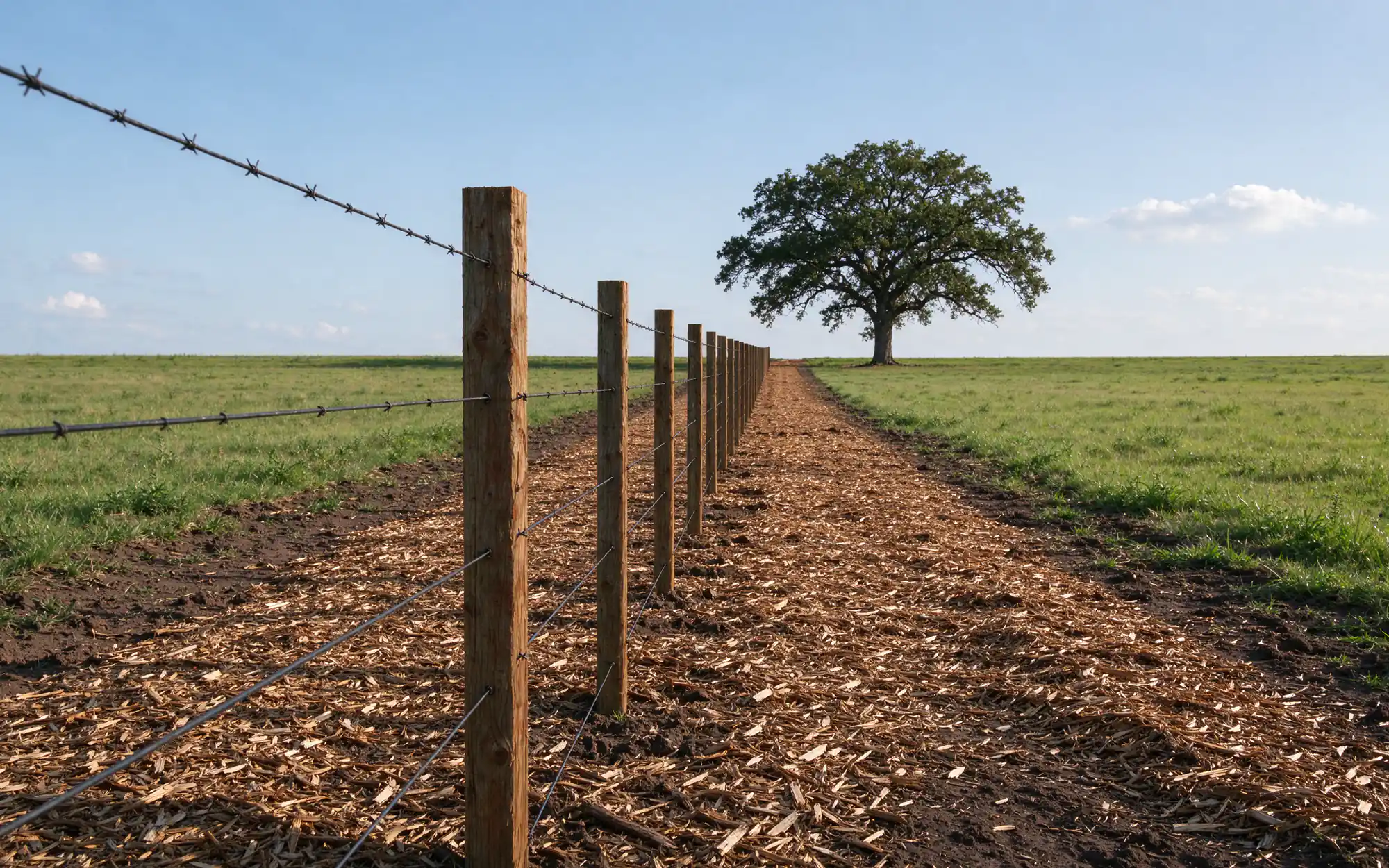
Texas Parks and Wildlife describes Collin County as Blackland Prairie that has mostly been farmed or ranched, with a remnant preserved at Parkhill Prairie. Unincorporated tracts tend to follow that history: open pasture, grown-up fencerows and creek bottoms. USDA NRCS soil data puts Houston Black clay across most of it, with frequently flooded Tinn clay on some creek bottoms, so wet-season timing matters. Common jobs on this ground are pasture clearing and bush hogging, fence line clearing ahead of a fence crew, and brush clearing of mesquite and cedar. Texas A&M AgriLife describes eastern redcedar as a non-resprouting juniper, while mesquite resprouts from buds below ground, which is why mesquite may call for clearing and grubbing rather than mowing.
Many of these tracts carry an agricultural valuation. Under Texas Tax Code 23.55, a change of use on 1-d-1 land triggers an additional tax covering the three preceding years. Whether a particular job changes the use is for the appraisal district to decide; the ag valuation guide explains the mechanics. Electric service varies by parcel among Oncor, CoServ and Grayson-Collin Electric Cooperative, so the line owner is confirmed per address. See the power line guide.
Prices for budgeting are in the cost per acre guide. When the questions above have answers, get in touch and the scope gets written around them.