
A builder needs the lot clear
The slab and driveway footprint needs stumps and roots out, while the rest of the lot may only need brush cut. Clearing stops where grading starts.
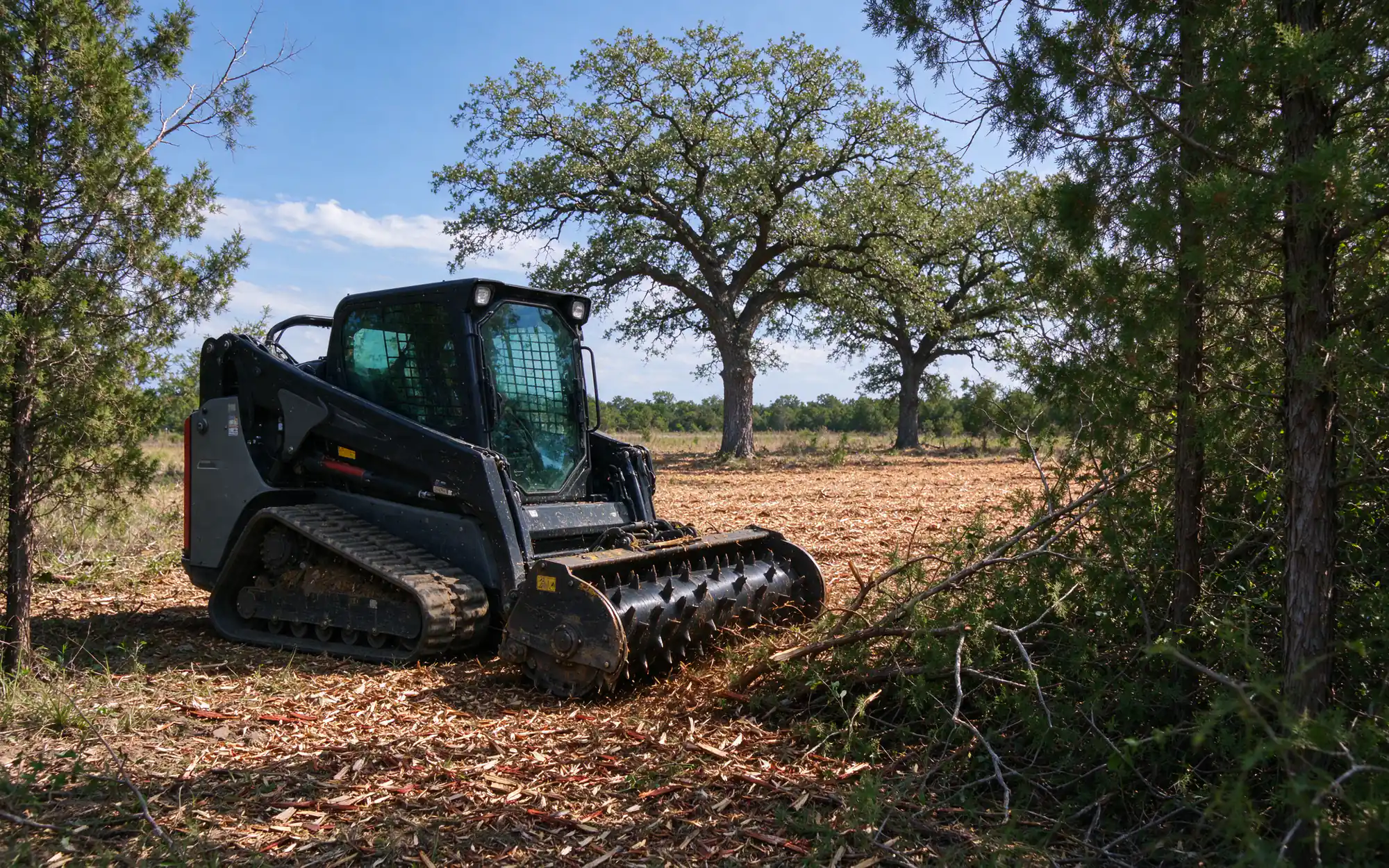
Lot clearing →Homestead Land Clearing clears cedar thickets, overgrown lots and acreage brush in Frisco and across Collin and Denton counties, using the method that fits the finish you need, with the trees you want marked and protected before a machine arrives.
6 inches
Trees this size and up are protected in Frisco, and removing them needs a permit outside platted home lots.
City of Frisco
1 acre
Disturbing this much ground brings the state construction stormwater permit into play.
Texas Commission on Environmental Quality
300 feet
Minimum distance from neighbors' homes for burning clearing debris where burning is allowed at all.
TCEQ outdoor burning rules
May and October
The wettest months at DFW, when clay ground is most likely to rut under machines.
NOAA climate normals
Most clearing jobs start with one of these. Each needs a different finish, which is why the method comes second.
The slab and driveway footprint needs stumps and roots out, while the rest of the lot may only need brush cut. Clearing stops where grading starts.
Lot clearing →Fence rows, pasture and old fields fill in with cedar, mesquite, hackberry and privet. Mulching in place is often the cleanest way back.
Brush clearing →Frisco requires ground vegetation under 12 inches. Inherited and out-of-town lots are the usual cases.
Overgrown lot clearing →Clearing to the site plan, silt fence before disturbance, and a clean handoff to the earthwork contractor.
Commercial land clearing →Twelve kinds of clearing work, each named for the finish it leaves. Two jobs that look alike from the road can need different machines, so start with the result you want.
The method decides what is left in the ground. That matters most if anything will be built, paved or planted afterward.
| Question | Forestry mulching | Clearing and grubbing | Selective clearing |
|---|---|---|---|
| Stumps | Ground near the surface; root systems stay | Pulled out with the root ball | Removed only where brush is cleared |
| Debris | Left on site as a mulch layer | Chipped, hauled, or burned where the rules allow | Mulched or hauled |
| Ground after | Covered, protected from washout | Bare soil that needs erosion control | Mostly undisturbed under kept trees |
| Best for | Pasture, trails, views, fire breaks | Slabs, pads, driveways, parking | Wooded home sites and shade lots |
Grading, pad building and dirt work are a separate trade. Clearing hands the site to the excavation contractor once the roots are out. Read the full comparison →
Budgeting ranges, not quotes. Density, stumps, access and what happens to the debris move a job inside these ranges.
$1,200 to $8,000
per acre, light brush to heavily wooded. North Texas pricing we reviewed falls in the same range.
HomeGuide, national
$1,200 to $2,000
per acre on large public right-of-way contracts in the Dallas district, which includes Collin and Denton counties.
Texas Department of Transportation bid results
$52 to $80
per ton at the regional landfill and transfer stations, one-ton minimum.
North Texas Municipal Water District
Stump grinding typically runs $120 to $400 for the first stump and $30 to $60 for each one after (HomeGuide, national). Brush and limbs go to the City of Plano's Custer Road yard-waste facility, which Frisco shares, for $22 per cubic yard with a $66 minimum. Run the cost estimator →
Every town around Frisco writes its own tree and burn rules. Pick yours to see what changes for your property.
Three checks happen before a machine is scheduled.
Removing trees in Frisco needs a permit unless the land is a platted single-family or duplex lot. Trees 6 inches and up are protected, and replacement runs 100 to 300 percent of the inches removed. Cut debris has to be chipped or hauled within 72 hours.
Frisco tree permit guide →Collin and Denton counties sit in the Dallas-Fort Worth ozone area, so state rules allow burning clearing debris only when there is no practical alternative, 300 feet from neighbors' homes. Frisco issues the permit to the landowner. Many jobs mulch or haul instead.
Burning rules guide →Disturbing an acre or more falls under the state construction stormwater permit, and five acres or more means filing a notice with the state. That is why silt fence often goes in before clearing starts.
Stormwater permit guide →The estimate is written from the property, not from a phone call, and the work is done by licensed and insured contractors.
Boundaries, trees to keep, slopes, wet spots, fences, and what is buried or overhead.
Tree permit, burn options, creek and floodplain limits, and utility locates for that address.
Method, finish, stumps, debris plan and erosion control, in writing, before a price.
The site is left at the agreed finish, ready for the next trade or for seeding.
No. A mulcher grinds trees, brush and stumps near the surface and leaves root systems in the ground. That works for pasture, trails and views. Anything that will carry a slab, driveway or parking surface needs the stumps and roots grubbed out of that footprint.
Usually not, if it is eastern redcedar. Texas A&M AgriLife Extension describes eastern redcedar as a non-resprouting juniper, so cedar cut below its lowest green branch tends to stay gone. Redberry juniper is different: AgriLife's Brush Busters guidance says it has to be grubbed below the soil surface. Mesquite and most hardwoods resprout from the roots, so they need follow-up or root removal.
Usually, and on bare clay it helps keep soil from washing off in heavy rain. A very deep layer can slow grass, and mulch has to come off any area that will be built on.
In Frisco, removing trees needs a permit unless the land is a platted single-family or duplex lot, and removing vegetation in a floodplain needs City approval. Neighboring towns write their own tree and burn rules, so check your town on the map above.
Sometimes. Collin and Denton counties are in the Dallas-Fort Worth ozone nonattainment area, where state rules allow burning land clearing debris only when there is no practical alternative, at least 300 feet from neighbors' homes and in the right wind. Frisco issues burn permits to the landowner, some towns do not issue them at all, and county burn bans can stop burning entirely.
No. Clearing removes vegetation, stumps and roots and leaves the ground at the agreed finish. Cutting, filling, building a pad or shaping drainage is earthwork, a separate trade that takes over once clearing is done.
Yes. Small jobs are scoped the same way as large ones, and the written scope says what the minimum visit covers. Equipment transport is a fixed part of any job, which is why one stump costs more per stump than ten.
Tell us where the property is, what you want it to look like after, and anything you know about trees, stumps or wet ground. Photos help.
(945) 455-4412Call