
Land clearing in Little Elm sits between two outside authorities: Denton County, which decides each morning whether anyone may burn, and the U.S. Army Corps of Engineers, which owns much of the Lewisville Lake shoreline. The Town adds its own layer: a $25 annual burn permit, inch-for-inch tree replacement and a grading permit that explicitly covers clearing and grubbing. Homestead Land Clearing scopes Little Elm work with all three in view. Census estimates put the town at 46,044 residents in 2020 and 62,727 by mid-2025, a 36.2% rise, with 850 and 414 single-family permits in 2024 and 2025.
What decides a Little Elm job
Burning takes two approvals. The Little Elm Fire Department requires a current burn permit for any outdoor burning. It is an annual permit requested through the Town’s MyGov portal, with a $25 fee invoiced after processing. Holding it is not enough: the burn must also follow TCEQ rules and fall on a burn day, which Denton County’s emergency management office determines. The county makes that call each morning, so a brush pile can sit for days. The burning guide covers how county burn bans fit on top, and debris removal is the fallback when burn days do not line up.
Trees are replaced inch for inch. The Town’s development handbook requires a tree survey identifying all trees, with protected trees defined as 6 inches in caliper or larger at 4 feet 6 inches above grade. Removing any requires a mitigation plan, and every protected tree is replaced with new trees whose total caliper equals what came out. That is flatter than Frisco’s scale, which climbs to 300% above 20 inches, but it covers every protected tree. Exemptions in the underlying code were not confirmed, so they are checked per address.
Clearing has its own permit path. Little Elm’s grading permit checklist states that work under the permit may include clearing, grubbing and earthwork, with plans sealed by a Texas professional engineer and submitted through MyGov. No work may happen in the floodplain without a separate Floodplain Permit, and the primary operator stays responsible for the site until TCEQ’s Notice of Termination is filed. For commercial land clearing and clearing and grubbing on development tracts, that permit is the first scheduling milestone.
How a Little Elm job usually runs
- Walk the property. Boundaries, trees to keep, slopes, wet spots, fences, and anything buried or overhead, including where the lot meets Corps land.
- Check the rules for that address. Tree survey and mitigation, grading or floodplain permits, burn permit and burn-day plan, and a Texas811 locate request.
- Write the scope. Method, finish level, stumps, debris plan and erosion control, in writing before a price.
- Clear and hand off. The site is left at the agreed finish, ready for the next trade or for seeding.
The lake changes the map
Little Elm wraps around Lewisville Lake, and the Corps’ real estate rules decide where private clearing ends. The Fort Worth District says land at or below 535 feet in elevation is generally owned in fee by the federal government, above a conservation pool of 522 feet. A flowage easement extends to the 537-foot contour, and written Corps permission is required for any work inside it. On public land, removing vegetation is prohibited outright. A lakeside lot clearing job therefore starts by finding the boundary markers, and nothing past them is part of any scope.
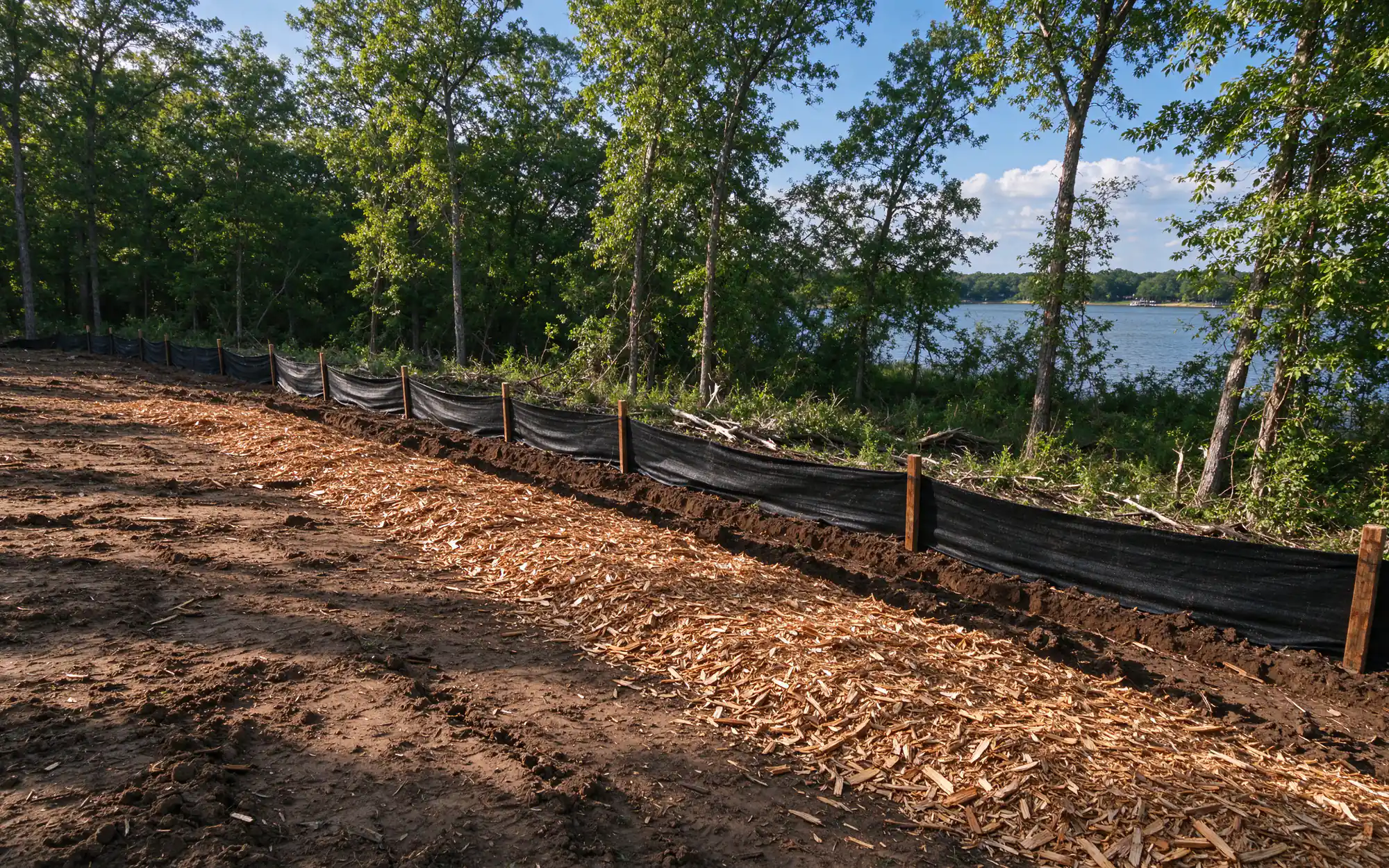
The ground near the water is its own problem. USDA NRCS soil data shows Branyon clay across much of the area and Ferris-Heiden clay on 5 to 15% slopes along the lake bluffs. Cleared bluff ground can wash quickly in a heavy rain, which makes silt fence and seeding worth pricing as add-ons; see erosion control after clearing and the creek and floodplain guide. Development sites of an acre or more also fall under TCEQ’s construction stormwater permit. Little Elm’s electric provider was not researched, so the line owner near a parcel is confirmed per address.
The Colony
The Colony shares the Lewisville Lake shoreline and the same Corps boundary rules, but its burn answer is simpler: the Fire Department states that the adopted International Fire Code prohibits open burning in city limits year-round. The city is also largely built out: Census building permit counts fell from 256 single-family permits in 2024 to 46 the next year, so most work there is overgrown lot clearing, brush clearing along back lines and hauling the material away.
Why plan it this way
In Little Elm, timing and boundaries carry more risk than the clearing itself. A quote that assumes burning has to account for days when the county says no, and a lakefront scope has to stop at federal land. Sorting those out first keeps a job from stalling halfway. Parcels just outside town limits follow Denton County instead, where the county runs open burning registration and makes the daily burn-day call; the unincorporated Denton County page covers that side.
Services for Little Elm and The Colony
- Lot clearing for home sites, with the tree survey and mitigation plan sorted first.
- Overgrown lot clearing for platted lots that have grown up in brush.
- Clearing and grubbing under a Little Elm grading permit on development tracts.
- Land clearing debris removal when burning is not allowed, as in The Colony, or the burn days do not cooperate.
Contact us with the lot size and what is growing on it.