
Last Updated:
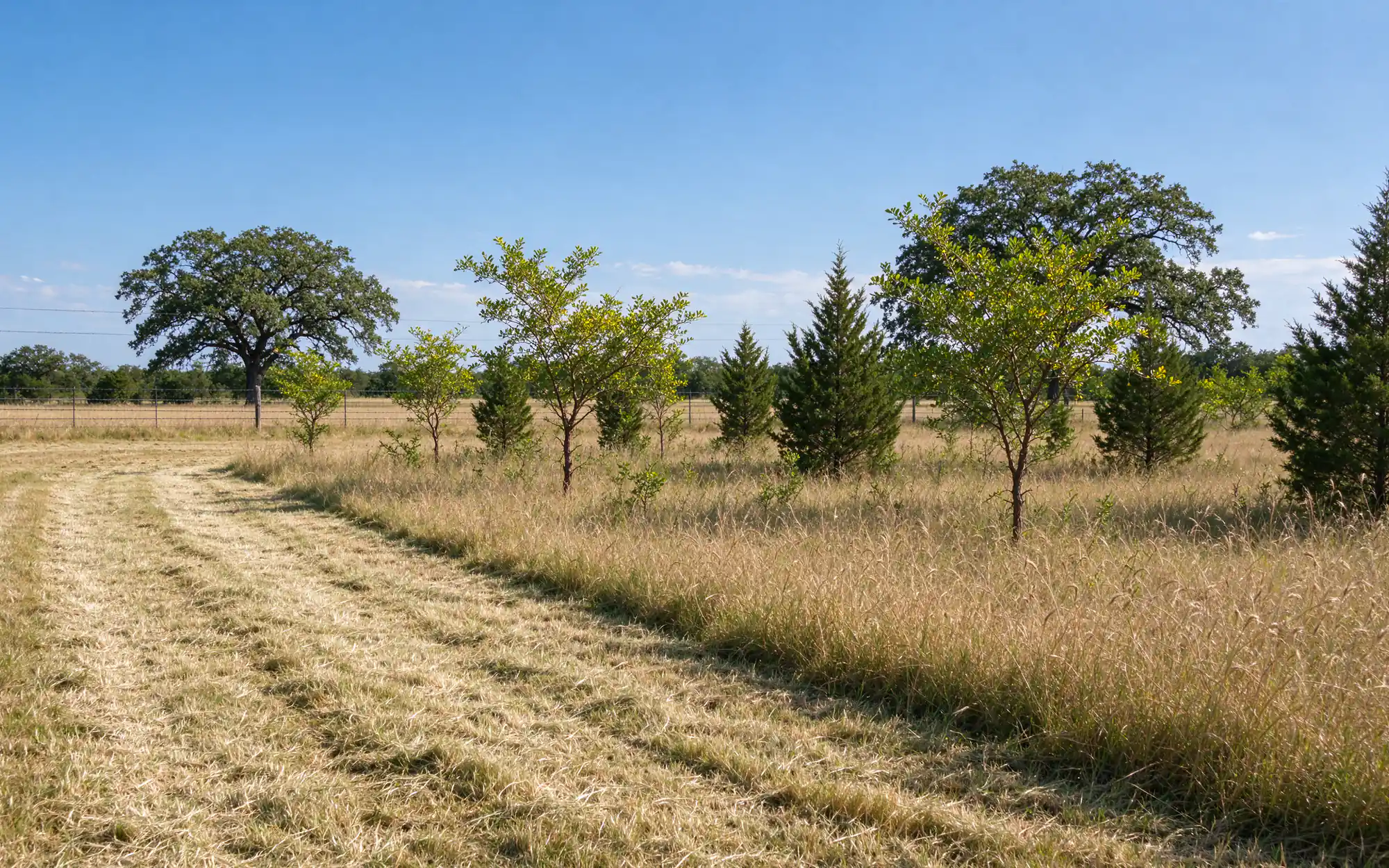
Pasture clearing means taking a field that has filled in with mesquite, cedar, briar and saplings and getting it back to grass you can graze, cut for hay or simply keep open. Homestead Land Clearing offers pasture clearing on acreage around Frisco and across Collin and Denton counties, with the work done by licensed and insured contractors. The job almost always runs in two stages. First the woody growth is knocked back by cutting, mulching or grubbing it. Then the grass and light growth are brought down with a rotary cutter, the work most owners call bush hogging or acreage mowing. Mowing alone rarely fixes a field that has gone to brush, and the reasons for that shape the whole scope.
What happens on the first visit
The first visit sorts out what the field is now, what you want it to be, and what stands in between. The planned process runs in four steps.
- Walk the property. Boundaries, fences and gates, the trees worth keeping for shade, slopes, wet spots and stock tanks, and anything buried or overhead. Tall grass hides old T-posts, wire, pipe and stumps that will break a mower.
- Check the rules for that address. Tree permit status, burn options, creek or floodplain limits, and utility locates through Texas811. In Frisco the City locates its own lines separately for permitted work.
- Write the scope. Method, finish level, stumps, debris plan and erosion control, all in writing, before a price.
- Clear and hand off. The field is left at the agreed finish, ready for mowing, planting or the next trade.
Knock the brush back first, then mow
A rotary cutter is a grass and light-brush tool. It handles weeds, tall grass and young woody stems well, and the brush clearing work that comes before it handles everything thicker. When a field has gone several seasons without mowing, mesquite and cedar saplings reach a size where the cutter either rides over them or shreds the tops and leaves ragged stubs. Those stubs puncture tires, catch the deck, and resprout.
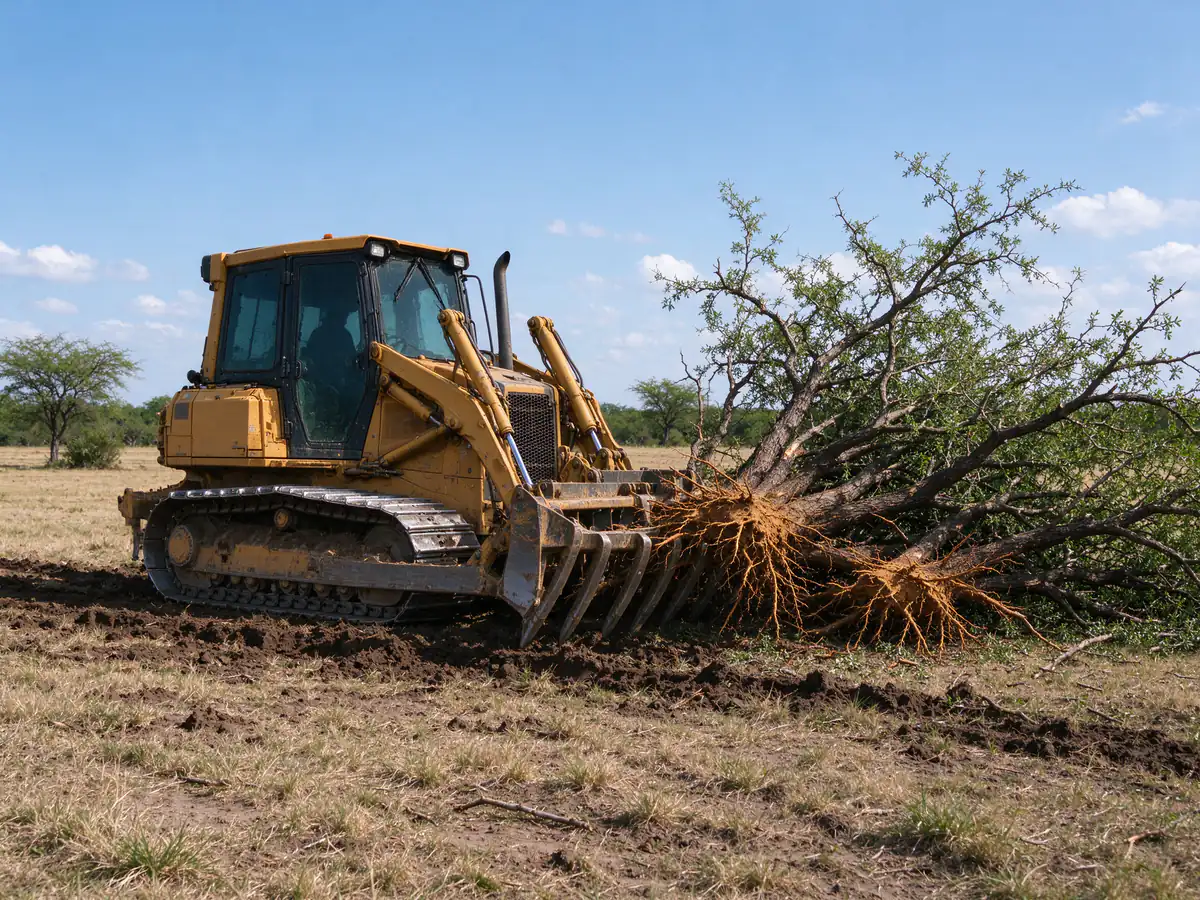
So the first pass deals with the woody growth. Depending on the field, that can be a forestry mulcher grinding saplings and small trees in place, a dozer or excavator pulling larger brush out by the roots, or a mix of both. Forestry mulching suits ground that will stay in grass, because it leaves a mulch layer and disturbs little soil. Grubbing suits ground that will be disked or planted, since roots left in the soil fight a seedbed. The guide on forestry mulching vs land clearing covers that choice in detail.
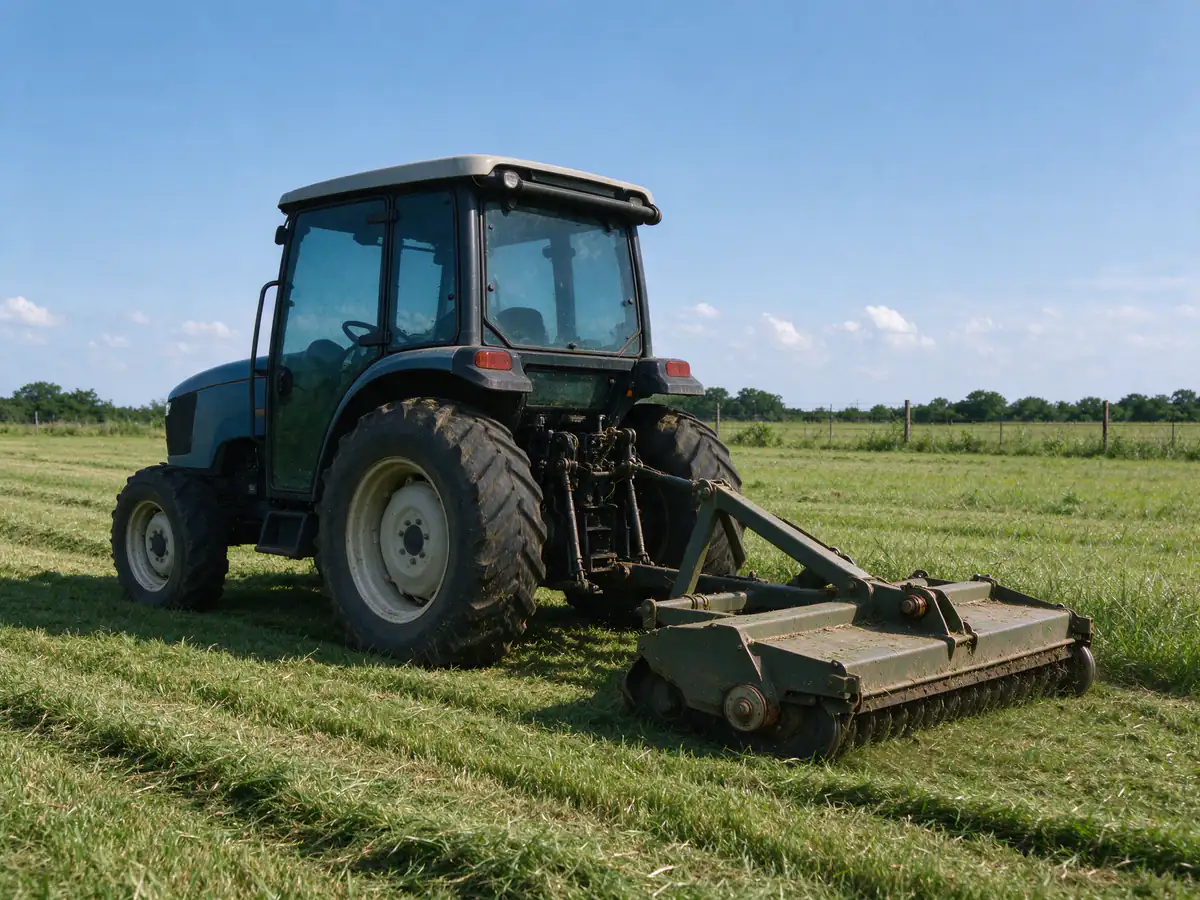
Once the woody stems are gone, bush hogging takes the grass and weeds down to a mowable height. On big, open acreage this pass moves fast; on fields with terraces, gullies or old fence lines it slows down, because each obstacle has to be seen before the deck reaches it. Fence lines are often the worst part of an old pasture, with brush grown through the wire. Clearing them is its own scope, covered under fence line clearing. Building or repairing the fence afterward is a separate trade.
What grows back, and what doesn’t
Regrowth decides whether a cleared pasture stays cleared. The species matter more than the method.
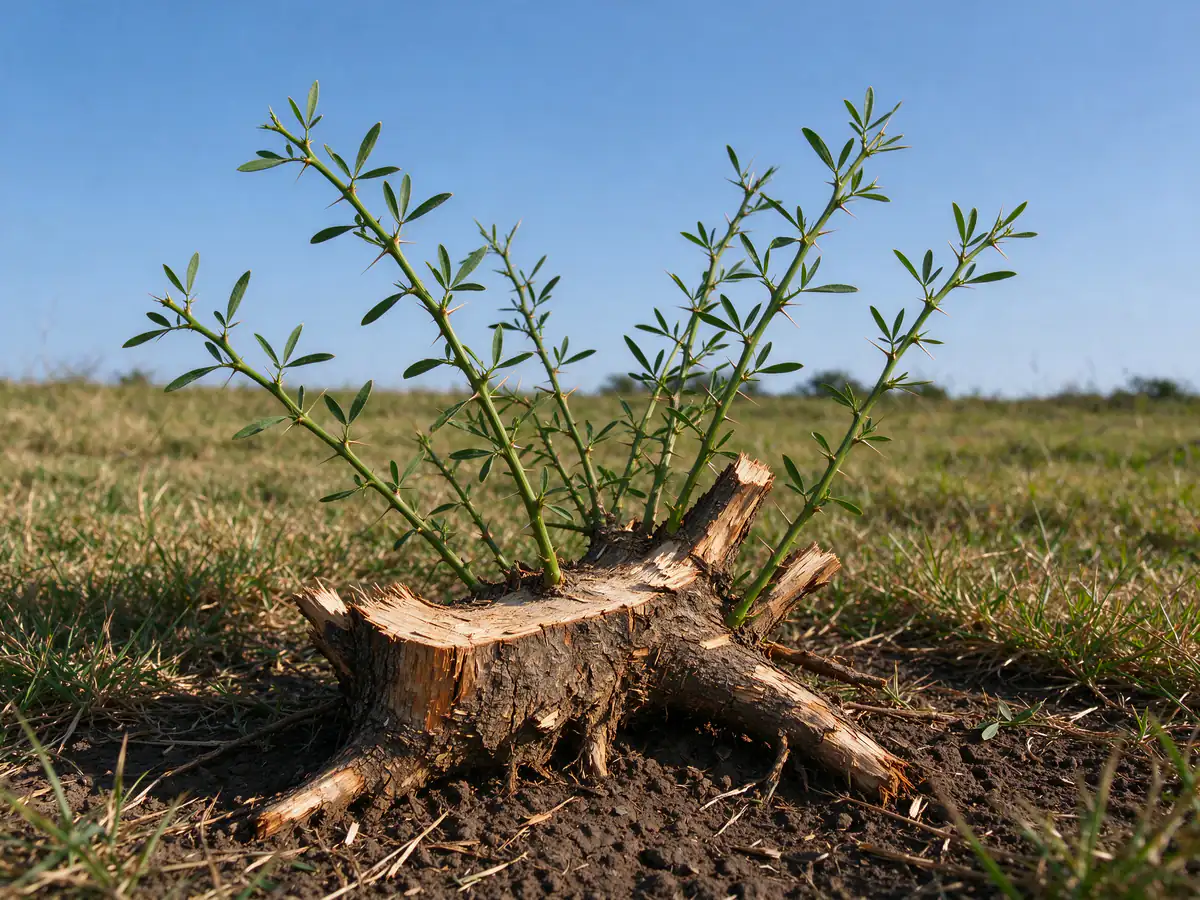
Texas A&M AgriLife Extension describes eastern redcedar as a non-resprouting juniper: cut below its lowest green limbs, it does not come back from the stump. Redberry juniper is different, and AgriLife’s Brush Busters program says it has to be grubbed out below the soil surface to keep it from resprouting. Mesquite is the hardest case. AgriLife explains that it resprouts from a bud bank below ground, so cutting or shredding the top tends to produce a multi-stemmed bush in its place. A scope that says “shred mesquite” without saying what happens to the root crown is promising a shorter mesquite, not a pasture.
That is why regrowth follow-up belongs in the first conversation. For most fields it comes down to regular mowing so new sprouts never get woody, plus grubbing where root sprouters are thick. Herbicide work is a separate service done by a licensed applicator and is not part of this scope. The guides on whether brush grows back after clearing and North Texas invasive brush go further species by species.
Ag valuation, rollback and how the land will be used
A lot of acreage around Frisco carries open-space agricultural valuation, often called 1-d-1. Texas Tax Code 23.55 says that when land under that valuation changes to a non-agricultural use, an additional tax is due for each of the three preceding years: the difference between the tax paid at agricultural value and the tax that market value would have produced. The chief appraiser of the county appraisal district decides whether a change of use has happened.
Clearing brush is not itself a change of use, and reclaiming a pasture for grazing or hay keeps the land in agriculture. Clearing a field to build on it is a different matter. This page is not tax advice. If a clearing project sits anywhere near that line, call the Collin or Denton County appraisal district first; the guide on ag exemption and land clearing explains the questions to ask.
Local rules can still apply to farm ground. In Frisco, agricultural users may remove protected trees with a tree removal permit and tree survey, and the replacement requirement is prorated over 10 years. Frisco’s floodplain rule exempts ongoing crop, hay and grazing use, but expanding agricultural use by clearing in the floodplain is covered, and the City can fine $300 per caliper inch, up to $2,000 per offense, with the contractor liable along with the owner. If the field runs down to a creek, read clearing near creeks and floodplain before anyone cuts.
NRCS EQIP brush management cost share
USDA’s Natural Resources Conservation Service funds brush management, conservation practice 314, through the Environmental Quality Incentives Program (EQIP). It is aimed at agricultural producers on eligible agricultural land, not at lot buyers or homeowners clearing a yard. Applications are ranked competitively, the work has to follow an NRCS conservation plan and practice standard, and payment rates are set by NRCS Texas and change over time.
The practical point is timing. Applications are accepted year-round and ranked in periodic batches, so the first stop is the local USDA Service Center, ideally before any clearing begins. Ask there how starting work early would affect eligibility. The post on the EQIP brush management application window explains how the ranking cycle works.
What pasture clearing costs
Pasture work is priced by the acre, by the hour or by the job, and the spread is wide because fields differ so much. For regional context, Texas A&M AgriLife Extension’s custom rates survey for the East Texas region, which includes Collin and Denton counties, reports dozer land-clearing rates of $120 to $250 per hour under 160 hp and $100 to $300 per hour over 160 hp. Those are farm and ranch figures that include operator, machine and fuel.
For brush itself, HomeGuide (national) lists light brush at $800 to $1,800 per acre, heavy brush at $1,600 to $3,000 per acre and wooded ground at $2,500 to $5,000 per acre. Large public right-of-way contracts in TxDOT’s Dallas district, which includes Collin and Denton, bid brush clearing at $1,200 to $2,000 per acre; that is big open acreage, not a small field. All of these are budgeting ranges, not company rates.
What moves a pasture price:
- Density and stem size. A field of grass with scattered saplings sits low; a mesquite thicket sits high.
- Finish level. Shredded and mowed costs less than grubbed and ready to disk.
- Hidden obstacles. Old wire, posts, concrete and stumps slow the work and can damage equipment.
- Access and wet ground. Gates, creek crossings and soft clay limit which machines can work and when.
- Debris. Mulch left in place costs least; hauling off brush adds disposal, covered on the land clearing debris removal page.
The land clearing cost estimator and the guide to land clearing cost per acre go further.
Seeding and erosion control after clearing
Grubbed or heavily disturbed ground needs cover before the wet months. Most of the Collin side sits on Houston Black and Austin clays, and NOAA’s 1991 to 2020 normals for DFW Airport show rain peaking in May (4.78 inches) and October (4.37 inches). Bare clay on a slope sheds soil in those storms. Seeding is offered as an add-on; for reference, HomeGuide (national) lists hydroseeding at $0.12 to $0.35 per square foot, and large TxDOT projects in North Texas run about $0.05 to $0.30. Silt fence along a downhill edge is the other common add-on. On land west toward Aubrey, Cross Timbers sandy loams replace the clay; they drain faster and stay workable sooner after rain. The guide on erosion control after land clearing covers the options.
What's included
- A walk of the pasture to mark fences, gates, water, wet spots, keeper trees and anything hidden in tall grass
- A check of the rules for that address: tree permit status, floodplain limits, burn options and utility locates
- A written scope naming the method, the finish level, how stumps are handled and where the debris goes
- Brush, saplings and small trees cut, mulched or removed inside the agreed limits
- Bush hogging or acreage mowing of the grass and light growth once woody stems are dealt with
- Grubbing of stumps and roots in areas that will be disked, planted or built on, where the scope calls for it
- Seeding of bare areas and silt fence along downhill edges as add-ons
Three ways to reclaim a brushy pasture, and what each one leaves
| Bush hogging / acreage mowing | Forestry mulching | Dozer clearing and grubbing | |
|---|---|---|---|
| What it handles | Grass, weeds and light, young woody growth | Brush, saplings and small trees up to the size the machine is rated for | Trees, thick brush, stumps and the main roots |
| What is left | Shredded grass and stems on the surface; root crowns intact | A mulch layer; stumps near grade, roots in the soil | Bare ground, with debris piled, hauled or chipped |
| Regrowth | Fast for anything that sprouts from the base or roots | Mesquite and other root sprouters come back; eastern redcedar does not resprout | Lowest, because crowns and roots come out |
| Best fit | Pasture that is mostly grass and needs to stay that way | A field that has gone to brush but will stay as grazing or open land | Ground that will be disked, planted to a crop or built on |
| Main trade-off | Repeats every season; misses anything too woody | Leaves roots, so follow-up mowing matters | Most soil disturbed, so erosion control and reseeding matter |
Related resources
- LearnWill clearing land trigger an ag exemption rollback tax?
- LearnDoes brush grow back after clearing?
- LearnWhat should you know about hackberry, privet and honey locust removal in North Texas?
- Decision GuideForestry mulching vs land clearing: which one does your property need?
- LearnHow do you control erosion after land clearing?
- Cost GuideHow much does land clearing cost per acre in North Texas?
Representative photos of this work
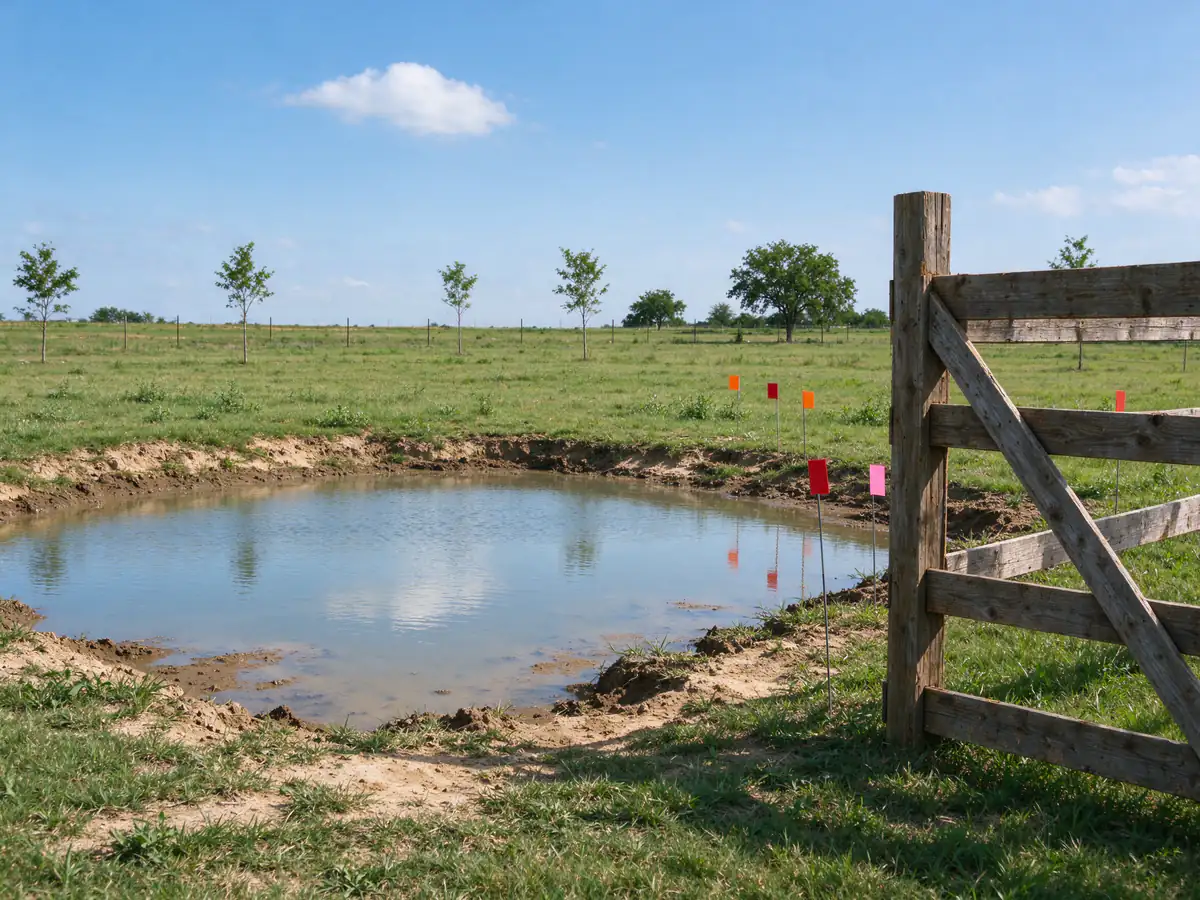
Representative photos of this type of work, not photos of specific completed jobs.