
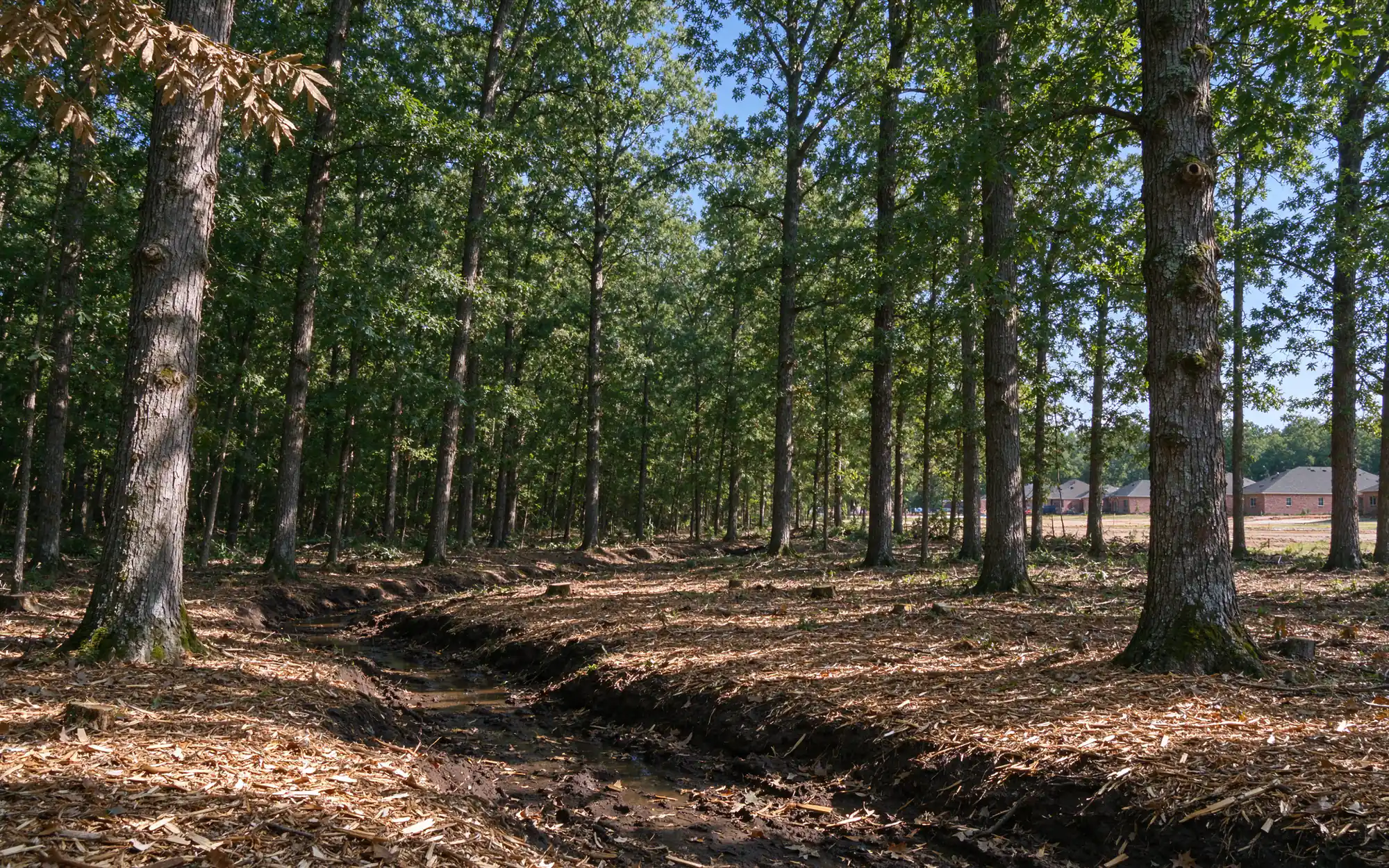
Land clearing in Anna comes down to one distinction the City drew in its 2023 tree ordinance: clearing under trees is allowed, clearing away the trees wholesale is not. Underbrush removal and clearing and grubbing under drip lines need no permit, while clear-cutting is prohibited unless a tree removal permit authorizes it. That makes Anna one of the more workable places in Collin County for brush clearing and understory mulching, as long as the job stays on the right side of that line. Homestead Land Clearing sets up Anna work by asking first whether the trees will stay. Census estimates show Anna more than doubled, from 17,137 residents in 2020 to 35,245 by mid-2025 (+105.7%), with 1,173 and 864 single-family permits in 2024 and 2025.
Anna’s tree rules in practice
What is protected. Anna’s Section 9.07, adopted August 8, 2023, protects quality trees from the City’s list at 6 inches in diameter and up, and specimen trees at 24 inches and up. That is the baseline for development tracts and commercial land, and it is the reason clearing and grubbing on a subdivision tract starts with a tree survey.
Where the threshold rises. Inside single-family and duplex subdivisions, outside the floodplain and erosion zones, the ordinance narrows replacement to quality trees of 18 inches or more, specimen trees, and any tree of 18 inches or more within 10 feet of a property line. That edge rule matters on a narrow lot, where a big tree on the side setback can count even if it is not on the quality list. Trees in the floodplain, in an NRCS lake tree preservation zone or in an erosion hazard area stay fully subject, and the City’s valuation table prices floodplain trees well above upland ones. The table’s dollar columns did not extract cleanly from the City’s document, so this page does not quote them.
Who is outside it. The ordinance does not apply to a single single-family or duplex residence built on a single lot that is not part of a subdivision, or to an end-user owner holding a certificate of occupancy. Where replacement does apply, new trees are at least 3 inches in diameter, so an 18-inch tree removed becomes six 3-inch trees planted.
Burning. Anna’s burn rules were not confirmed in the research behind this page, so they are checked with the City for each address. Outside city limits, the Collin County Fire Marshal states that no county office issues burn permits and only TCEQ decides whether a land clearing burn qualifies. The Collin and Denton burning guide explains those state rules.
How an Anna job usually runs
- Walk the property. Boundaries, trees to keep, slopes, wet spots, fences, and anything buried or overhead. In Anna, the walk separates understory work from any tree that would actually come out.
- Check the rules for that address. Subdivision lot or single lot, floodplain or erosion zone, tree removal permit, burn options and a Texas811 locate request.
- Write the scope. Method, finish level, stumps, debris plan and erosion control, in writing before a price.
- Clear and hand off. The site is left at the agreed finish, ready for the next trade or for seeding. Grading and pads are a separate trade.
Reading Anna and Melissa land
Anna’s soils follow the same Blackland pattern as the rest of eastern Collin County, with local twists. USDA NRCS soil data shows Houston Black clay on most of the flats, eroded Eddy gravelly clay loam on some slopes, and Frio clay loam rated occasionally flooded along creek bottoms. The gravelly, eroded slopes are where cleared ground is most likely to wash, so silt fence and seeding are worth pricing as add-ons there; the creek bottoms are where Anna’s fully covered floodplain trees stand. For a lot that will carry a house, clearing land to build a house covers grubbing the slab and driveway footprint while leaving the rest.
Growth sets the rhythm of the work. Between subdivisions that are filling in along US 75 and SH 121, Anna still has older tracts where brush has taken over pasture edges and fencerows. An overgrown lot clearing job on a platted lot inside a finished subdivision and a 20-acre understory job on the edge of town fall under different parts of the same ordinance, and the scope should say which one applies. The quote checklist lists what that scope should name.
Melissa
Melissa, Anna’s neighbor to the south along US 75, grew from 13,900 residents in 2020 to 29,969 by mid-2025 (U.S. Census), and it is home to North Texas Municipal Water District’s 121 Regional Disposal Facility on Sam Rayburn Highway. NTMWD lists $52 per ton there, one-ton minimum, against $80 per ton at its transfer stations, and Frisco directs residents’ stumps and root balls to that landfill. For Anna and Melissa jobs that need debris removal, that short haul is a real factor in the disposal line of a quote. Melissa’s tree rules are less clear: an older City tree removal permit form states that a permit is needed before removing trees, even ones otherwise treated as unprotected, but the form’s age means Melissa requirements are confirmed per address with the City before work starts.
Why plan it this way
Anna’s ordinance rewards precision. Underbrushing beneath a stand of pecans is exempt; taking the pecans is not, and a clear-cut without a permit is the outcome the rule exists to stop. Writing the scope around which trees stay keeps a job in the exempt column when that is the goal. Clearing that disturbs an acre or more also triggers TCEQ’s construction stormwater permit, and the difference between clearing and grubbing decides what the next trade inherits.
Services for Anna and Melissa properties
- Brush clearing and forestry mulching for understory work that stays permit-exempt.
- Lot clearing and stump grinding and removal for home sites.
- Clearing and grubbing on subdivision and commercial tracts with a tree survey.
- Creek-edge planning where floodplain trees are involved.
In Anna, the cleanest jobs start by deciding which trees stay. Get in touch with the address and what you want the land to look like when it is done.