
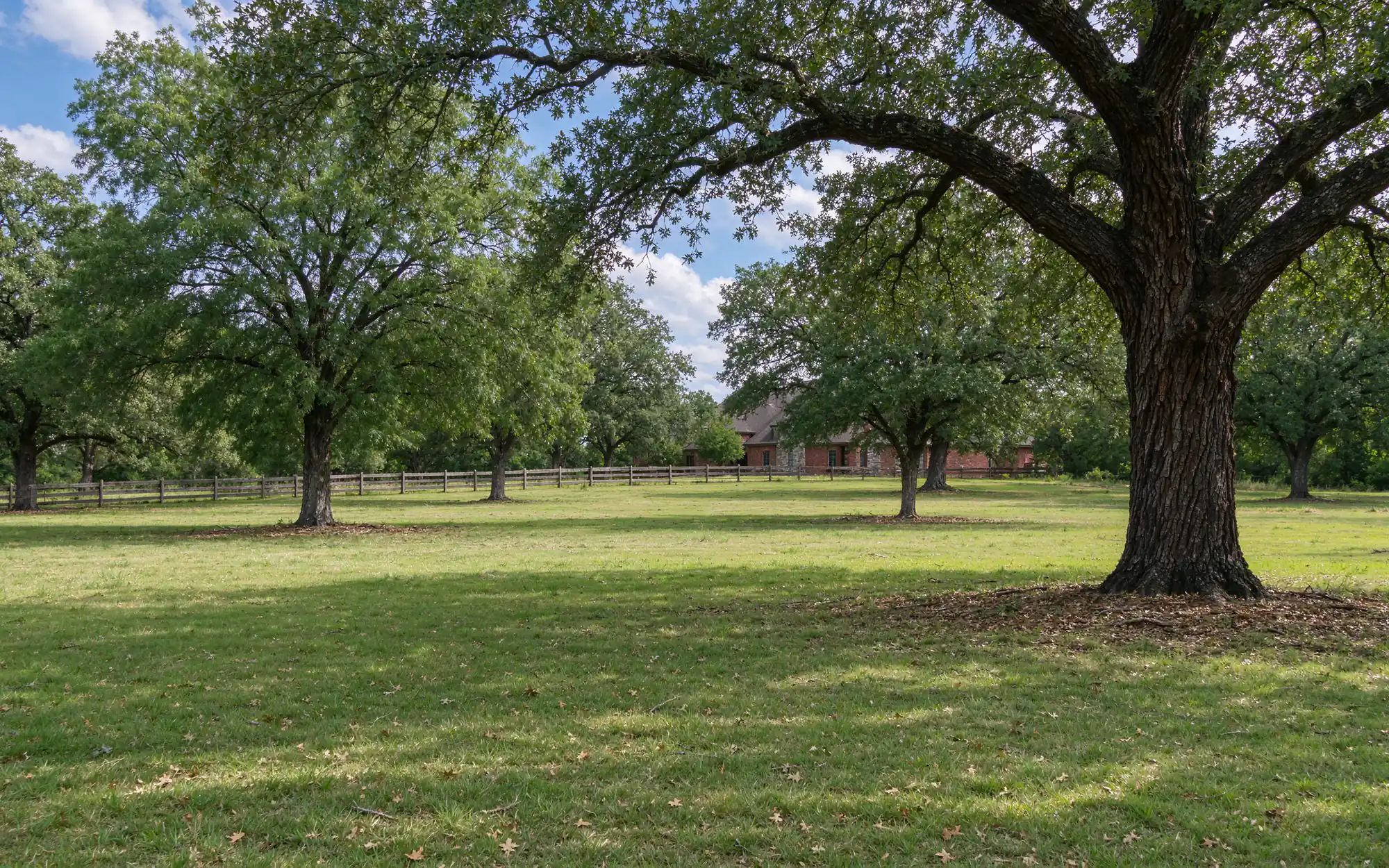
Fairview writes its equipment rule into code. Its tree protection article bans clear-cutting outright and bars dozers, loaders and other heavy earth-moving equipment from clearing or grubbing brush under the drip lines of protected trees; underbrush there comes out by hand or with mowers, under a permit. That makes land clearing in Fairview, TX a selective job almost by definition, and it is why Homestead Land Clearing scopes Fairview acreage around the canopy before it thinks about machines.
What Fairview’s code decides
The thresholds are low. Fairview counts a quality tree as protected from 4 inches in diameter, an understory tree from 2 inches and a marginal tree from 6 inches. A fencerow that looks like brush can hold dozens of protected stems. Removed protected trees are replaced with quality trees of equal or greater total diameter, each at least 3 inches and 7 feet tall.
Thinning is allowed and encouraged. The landscape administrator can approve selective thinning as a single permit when it improves the survival of the trees that remain. That is the core of selective clearing: take out the cedar, dead wood and crowded understory, and leave the trees the code values. Where roots of a removed tree tangle with a saved one, the code allows stump grinding rather than pulling.
Two allowances cover many acreage jobs. Trees within a total of 2 acres around the owner’s homestead residence are exempt from protection and replacement. Property zoned AG and actively farmed may remove up to seven protected trees per calendar year without a permit, and the article says it does not mean to stop clearing for legitimate agricultural use. Past seven trees, a permit follows an on-site inspection.
Burning is not banned outright, but it is narrow. The Fire Marshal may permit burning of natural vegetation on property of 10 acres or more after a site inspection. The burn sits at least 300 feet from any structure and 25 feet from property lines, with water on site, on a Fire Chief-designated day, and not on ozone alert days, before 8 a.m. or after 5 p.m. Under 10 acres, brush is mulched or hauled. The burning guide explains how county burn bans layer on top.
What the drip-line rule means on the ground
A drip line is the outer edge of a tree’s canopy, and most of the roots that feed the tree sit in the top layer of soil beneath it. A dozer blade working that zone scrapes and tears those roots, and the weight of a loader packs the clay so water and air reach them more slowly. Fairview’s rule keeps that damage off the trees it protects by limiting what may work there, not by forbidding the work.
In practice a Fairview property is split into zones before anyone prices it. Open ground away from protected canopies can take a mulcher or other tracked machine. Inside the drip lines, underbrush is cut by hand or mown under permit, and the cut material is carried or dragged out to where it can be mulched or loaded. That hand zone moves slower per square foot than open ground, which is why the boundary between zones belongs in the written scope rather than being decided on the day.
How a Fairview job usually runs
- Walk the property, marking protected trees, drip lines, slopes, wet spots, fences and anything buried or overhead.
- Check the rules for that address: the homestead and AG allowances, whether a thinning or underbrush permit is needed, burn eligibility, creek limits and Texas811.
- Write the scope before a price: method by zone (mower or hand under canopies, mulcher in the open), finish level, stumps, debris and erosion control.
- Clear and hand off at the agreed finish.
Reading Fairview acreage
Fairview is close to built out. Census counted 32 single-family permits in 2024 and 33 the year after, and population rose only 5.2 percent from 2020 to mid-2025. The clearing work here is mostly on existing acreage: pastures going back to brush, overgrown fence lines and the wooded backs of large lots. Texas Parks and Wildlife describes Collin County as Blackland Prairie that has mostly been farmed or ranched, so the woody growth tends to follow the fences and drainages. Pasture clearing and fence line clearing suit that ground well when the protected trees are flagged first.
USDA NRCS data shows Houston Black clay across most of town, with eroded Altoga silty clay on 5 to 8 percent slopes and Tinn clay and Frio clay loam on creek bottoms. Along those drainages, the no-dozer rule and floodplain limits can both apply; the creek and floodplain guide covers that ground.
Equipment choice follows the code. A forestry mulcher works open brush, while drip-line zones get mowers or hand crews. The mulching versus clearing guide explains the finish each leaves. On fencerows full of invasive growth, the invasive brush guide helps decide what to cut and what to watch for regrowth.
Services for Fairview properties
- Brush clearing for cedar and understory in the open.
- Debris removal on tracts under 10 acres.
Timing matters on Fairview clay. NOAA’s 1991 to 2020 normals at DFW Airport put May and October as the wettest months, and mowers and mulchers rut soaked Houston Black clay, so wet weeks often push work back. Clearing that disturbs an acre or more also falls under TCEQ’s construction stormwater permit.
If the property carries an agricultural valuation, the ag valuation guide explains how a change of use is treated; that is separate from the Town’s AG zoning allowance.
In Fairview, the useful first question is not how much to clear but which trees stay and how close a machine may go. Get in touch with the address to start there.